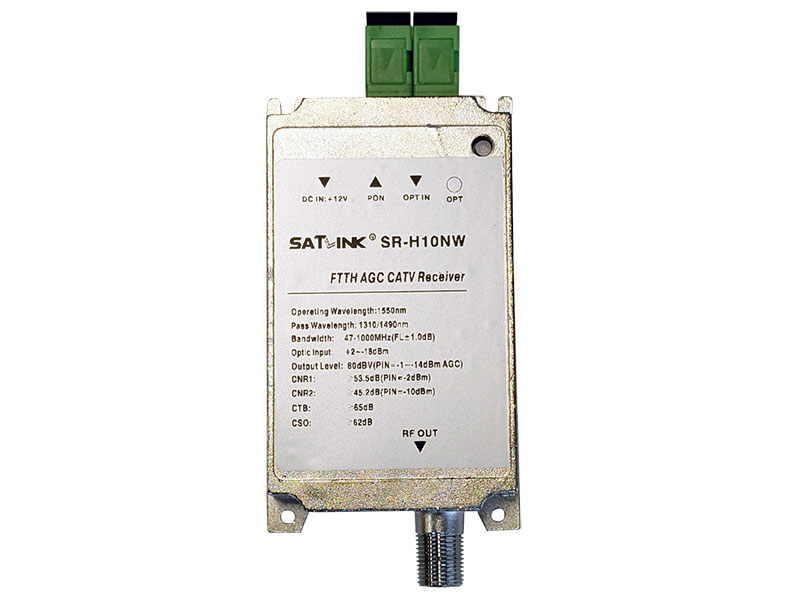
Description
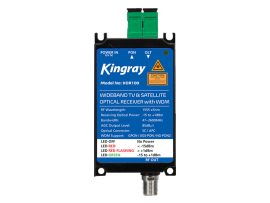
Satlink SR-H10NW Fibre to RF Receiver with AGC
Key Features
- Incudes 12V Power Supply
- Frequency Range 47~1000 MHz
- Built-in WDM to separate wavelengths of 1555nm (CATV) and GPON, XGS-PON, NG-PON2 (data)
- Receiving Sensitivity Range: -13dBm to +2dBm
- RF Output Level with AGC: 80 dBμV
- Suitable for Digital DVB-T TV signals
- LED Indicator
- Compact in design, wall mountable and light weight
- Optical Connector: SC/APC
- RF Connector: F-Female
Specifications
Interface
RF Connector: F-Female
Optical Connectors: SC/APC
Power Supply: 12VDC 2.1mm Plug
Optical Parameters
Responsivity: >0.9a/w
Receive Optical Power: -13~+2dBm
Optical Return Loss: >45dB
Receiver Wavelength: 1550nm with WDM & Block Filter
Pass Wavelength: GPON 1310/1490
Optical Fibre Type: Single Mode
RF Parameters
Frequency Range: 47-1000MHz
Flatness: ±0.75dB
Output Level: >80dBμV
CNR: >52dB
CSO: >65dB
CTB: >63dB
Return Loss: >14dB
AGC Stability: ±1dB
Output Impedance: 75Ω
Power Supply
Voltage: 12VDC
Power Consumption: <2W
Dimensions 115x 50 x 25mm
RF over fiber (RFoF) is a technology that enables the transmission of radio frequency (RF) signals over optical fiber cables. It combines the advantages of both radio frequency and fiber optic communication systems, providing long-distance transmission, low signal loss, high bandwidth, and immunity to electromagnetic interference. RFoF is commonly used in various applications, including telecommunications, satellite communications, wireless networks, and military systems.
Here’s a basic explanation of how RF over fiber works:
- Modulation: The RF signal, typically in the range of a few megahertz (MHz) to several gigahertz (GHz), is modulated onto an optical carrier signal. Modulation can be done using techniques like intensity modulation, where the intensity of the optical signal is varied according to the amplitude of the RF signal.
- Optical Transmission: The modulated optical signal is then transmitted over a single-mode or multimode optical fiber. Optical fibers are used because they offer low signal attenuation and can transmit data over long distances with minimal losses.
- Fiber Link: The optical fiber serves as a transmission medium, and it carries the modulated RF signal from one end to the other. The RFoF link can span several kilometers or even longer, depending on the quality of the optical fiber used.
- Optical-to-Electrical Conversion: At the receiving end of the fiber link, the optical signal is converted back into an electrical signal. This process involves using an optical receiver that converts the light signals into electrical currents.
- Demodulation: The electrical signal is then demodulated to retrieve the original RF signal. The demodulation process essentially reverses the modulation performed at the transmitting end.
- Signal Amplification: In some cases, signal amplifiers might be used at certain intervals along the fiber link to compensate for signal losses and maintain signal integrity.
Benefits of RF over Fiber:
- Signal Quality: RFoF preserves the signal quality over long distances, as optical fiber has very low signal attenuation compared to traditional coaxial cables.
- EMI Immunity: Since the RF signals are transmitted optically, RFoF is immune to electromagnetic interference (EMI) and radio frequency interference (RFI).
- Bandwidth: Optical fibers offer high bandwidth capabilities, allowing for the transmission of a wide range of RF frequencies simultaneously.
- Lightweight and Compact: RFoF systems can replace bulky and heavy coaxial cables, making installations more manageable and efficient.
- Secure Communication: Optical fibers provide a high level of security as they are difficult to tap into or intercept compared to traditional copper cables.
RF over fiber is a versatile technology that can be used in various applications where long-distance, high-quality RF signal transmission is required. Its ability to integrate with existing fiber optic infrastructure and radio frequency systems makes it an attractive solution for modern communication networks.